There’s something alarming about hearing the same words from different people over different seasons of your life. “Dali, you’re too good.” Every person I’ve ever loved has said this to me, and for the longest time, I thought it was just another version of “it’s not you, it’s me”—that white lie meant to soften the impact of leaving. But when the same phrase keeps appearing, when it becomes a pattern that follows you from relationship to relationship, you start to wonder if there’s something you’ve missed.
I used to dismiss it, convince myself it was coincidence. But recently, those words found their way back into my consciousness after you said something that cut straight through to the heart of it all: “It’s almost like you have a core belief that it’s too good to be true for you. That you don’t deserve something this good. So you shoot yourself in the foot before you even start.”
“It’s almost like you have a core belief that it’s too good to be true for you. That you don’t deserve something this good. So you shoot yourself in the foot before you even start.”
In that moment, everything shifted. I could almost see the contraption of my own self-destruction so clearly that it shook my very core. In the same way people told me I was “too good” for them—I had been telling myself that you were too good for me. What a brilliant, twisted self-fulfilling prophecy.
The Stories We Inherit
We don’t come into this world believing we’re unworthy of love. That’s something we learn, something that gets programmed into us through countless small moments and messages that torpedo us into a belief we shouldn’t have in the first place. It may be true that the culture we experience teaches us that love is conditional, that it must be earned, that real connection is somehow scarce—reserved for the chosen few who fit certain criteria of worthiness.
I think about the stories we consume, the narratives that shape our understanding of what love should look like. We’re stuffed with this idea that real love exists in movies and books, that it’s something that happens to other people, the protagonists who finally choose themselves and follow their hearts toward some beautiful, meaningful ending. But here we are, living in the space between scenes, where there’s no soundtrack swelling to tell us we’re making the right choice, no dialogue promising that everything will work out if we just have courage.
When someone says we’re “too good,” they’re not really talking about us. They’re projecting their own relationship with unworthiness, their own inability to receive love without suspicion. But here’s what I’ve come to understand: we do the same thing to ourselves. We take that external rejection and turn it inward, making it a core belief about what we deserve.
The Safety of ‘Almost’
There’s an unpleasant, subtle fear that comes with realizing you might actually deserve something beautiful. It’s easier, in some ways, to live with longing than to live with having. Longing is familiar—it’s safe because it keeps love at a distance where it can’t disappoint us. But having? Having requires us to be comfortable with the idea that we’re worthy of care without conditions, love without transaction.
I’ve spent years waiting for connections like this one, dreaming of the version of love that sees you completely and chooses to stay. But when it finally arrived—imperfect, complicated, real—I found myself looking for exits, creating distance where there could be intimacy. Not because the love wasn’t good enough, but because I had been conditioned to believe it couldn’t possibly be meant for me.
This is how we cripple our own capacity for joy. We create drama where there could be calm. We choose familiar patterns of emotional scarcity over the unfamiliar space of abundance. We become so accustomed to bread crumbs that a feast feels like a setup for ultimate disappointment and heartache.
“Your nervous system will always choose a familiar hell over unfamiliar heaven. Heal, so you can choose differently.”
The reality isn’t that love is impossible—it is that we’ve been programmed to believe it’s impossible for us specifically. That we’re somehow exempt from the basic human experience of being seen, known, and chosen without having to earn it first.
But recognizing the pattern is the first step toward breaking it. When I caught myself in that moment of projection—seeing you as “too good” for me just as others had seen me as “too good” for them—everything suddenly started to make sense. I realized that this wasn’t personal pathology but collective conditioning. We’ve all been taught to protect our own hearts, to reject the possibility that we might deserve tenderness without having to prove ourselves worthy of it first.
The work, then, becomes about unlearning these unhealthy narratives. It’s about interrogating that voice that convinces us we’re “too much” or “too little.” It requires what I can only call radical self-acceptance—the act of believing we deserve care not because we’ve earned it, but simply because we exist.
Choosing Love as Resistance
Love isn’t a Netflix series with a neat finale. It is messier, more uncertain, more real. Love asks us to show up imperfectly, to risk disappointment, to choose connection over the safety of isolation. Love is an act of resistance against every force that has taught us we’re not worthy of it.
Love is an act of resistance against every force that has taught us we’re not worthy of it.
Sometimes I think about how different things might be if we could just accept love when it arrives—not the perfect love we’ve been conditioned to expect, but the human love that’s available to us right here, right now. What if we could trust that we don’t need to be “too good” or “good enough” but exactly as we are, with all our uncertainties and fears and hopes?
The question isn’t whether we deserve love. The question is whether we have the courage to accept it when it shows up, whether we can resist the urge to sabotage what we’ve been waiting for simply because it feels too good to be true.
Maybe the real revolution is in believing that it’s not too good to be true—it’s just good enough to be real. And maybe, just maybe, that’s exactly what we deserve.
There’s something subtle and understated that happens when we say yes too often. It’s not loud or dramatic. It’s a quiet fading away of our own needs, our own boundaries, and even our own voice. It doesn’t happen overnight. Instead, it seeps in slowly, coated in gestures of kindness, duty, or responsibility. We say yes because we want to be helpful. Because we want to avoid conflict. Because we want to be seen, to feel needed. But here’s the truth: every time we say yes to something that drains us, we’re actually saying no to ourselves—and sometimes without even realizing it.
The Quiet Cost of People-Pleasing
People-pleasing runs deeper than just wanting to get along. It’s a pattern of quietly leaving yourself behind. We grow up learning that our worth comes from how much we give, how much we sacrifice, how small we can make our own needs. Saying no feels risky—like we might lose love or approval. So we say yes, again and again, even when our energy is depleted.
Over time, these yeses we hand out to keep the peace chip away at our energy, time, and sense of self. So much so that we become tired, resentful, and disconnected from what really matters to us. Yet within that challenge lies the antidote—the courage to show up for ourselves with kindness and honesty.
Saying ‘No’ as an Act of Self-Love
Saying no is not about being unkind or selfish. It’s about honoring your worth and protecting your well-being. When you say no, you are creating a boundary that keeps your energy safe from being consumed by bottomless demands.
Saying no doesn’t close doors. It encourages space. Space to breathe, to heal, and to focus on what truly feeds your soul. It’s a choice to live intentionally, aligned with your values instead of being pulled in every direction and stretching yourself too thin.
When you learn to say no without guilt or fear, you reclaim your power. You learn that self-love sometimes looks like a gentle, yet firm refusal that honors who you are and what you need. In doing so, you create space for healing, for your own growth, and for your general well-being.
Saying ‘Yes’ to Yourself
When you say no to others, you’re actually saying yes to your own peace, your important priorities, and your limited time. It’s choosing to live with intention, rather than through reaction.
You stop attending to everyone else’s needs and instead begin to design a pace that works for you. One that respects your limits, celebrates your desires, and protects your right to pause, rest, and recharge.
Slowly but surely, you’ll come to learn that in those moments of saying yes to yourself, you begin to peel back the nuanced layers of obligation and expectation. You begin to reconnect with yourself again—the person who matters most in your own story.
The Bottom Line
If you’re feeling burdened beneath the heavy weight of always giving like a bottomless well, know this: you have permission to pause. To take a step back. To say no. Saying no is really deciding to show up for yourself similar to how you previously showed up for everybody else.
The bottom line? No is kind. When you protect your time, you create space for a life that feels real, whole, and fully yours. That’s where you start to grow.
Should you ask me where I would go if I could. I would say, Capilano. My head has been suspended there since I was there last. My memories, too—the ones they tell me to forget and move on from.
I bet the river still whispers my name there. Or perhaps weeps for my bare feet running across the rainforest and my laughter rippling through it seamlessly.
In Capilano, I tasted a brand of dopamine they don’t sell at pharmacies. Called childhood. I was a child then with knuckles white, hanging onto the railings as the bridge rocked from right to left and from left to right…
In Capilano, I was young, naive, and happy.
If you need me, I’ll be down at Capilano. Where the trees are that olive green I can’t seem to forget. Even if I wanted to. And sometimes, I really do want to.
I built my world around you, every cup of tea a promise to honor your stubborn memory.
Though our time together was short as your temper, I couldn’t imagine being with anybody else after.
That’s the thing about love— it doesn’t just leave. It lingers, even when it hurts, like the smell of smoke knitted into your favorite sweater, or the hum of a song you can’t bear to remember.
This city isn’t the same since you left. The streets feel larger, as though they’ve significantly stretched to persuade me out of searching for you.
Your name sits in my throat, stubborn and soft, like honey: too thick to swallow, too sweet to forget.
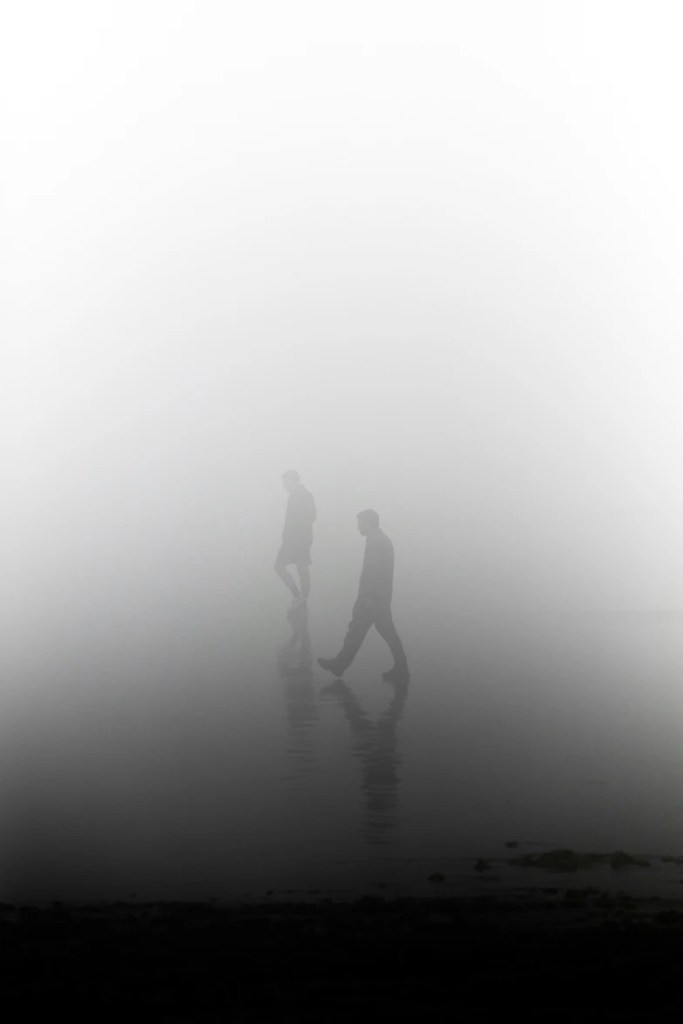
There’s a kind of quiet that only comes with uncertainty—a strange, almost comforting fog that rolls in when you’re standing at a crossroad, feeling as though you could step in any direction—or choose to stay right where you are. Maybe I was waiting for something, hoping that if I held still long enough, the right answer would find me. But life doesn’t always present you with a clear path forward. It keeps you in that fog, where each step feels as unsure as the last, and each decision—big or small—takes you further from the safety of everything you know.
In a way, it’s like floating between worlds. When you don’t know what’s next, you’re both nowhere and everywhere. That space between here and there makes everything seem both possible and impossible at once. But then fear starts to linger—the fear that if you make the wrong move, you’ll be lost forever. That fear has kept me rooted, motionless, more times than I’d like to admit.
Sitting in the Fog of Doubt
The first thing uncertainty does to us is that it strips away everything familiar. It leaves us exposed, sitting there with nothing but the questions we’re too afraid to ask yourself. We feel the weight of all the choices you’ve made and the choices we haven’t made yet, and of the lives we could have led if we have chosen a different way. And there’s an undeniable fear—not the fear of failure, but the fear of making a decision we cannot undo, of stepping forward and realising that the ground beneath us isn’t solid.
“The first thing uncertainty does to us is that it strips away everything familiar. It leaves us exposed, sitting there with nothing but the questions we’re too afraid to ask yourself.”
Carl Jung (1968) proposes that this experience forces us to tap into the process of individuation, where we embark on a journey toward becoming a whole, perhaps a more authentic self. In moments of uncertainty, we are often confronted with the disintegration of the persona we wear at work, in social settings, and even around our families—forcing us to reckon with the parts of ourselves that we’ve buried. This confrontation with the unknown reflects the disorientation one feels in the fog of doubt, where there is an inner tension between holding onto familiar roles and embracing the unknown that comes with new choices.
We often choose to wait in the midst of chaos. We convince ourselves that staying still is the safest option, that we’re being cautious, responsible. But deep down, we know it’s just an excuse to avoid making a choice. The fog becomes comforting, a place where we can putter without having to answer for anything. Yet, the longer we stay there, the heavier it feels, like a weight pressing down, reminding us that waiting isn’t the same as moving forward. Sooner or later, we begin to challenge our decision to wait.
“In moments of uncertainty, we are often confronted with the disintegration of the persona we wear at work, in social settings, and even around our families—forcing us to reckon with the parts of ourselves that we’ve buried.”
The Illusion of Control
There’s a certain comfort in convincing ourselves that it’s the circumstances, not our choices, that are keeping us where we are, on a personal or collective consciousness level. We shrug and say “It wasn’t meant to happen,” or “It simply didn’t work out”, and for a moment it feels easier to let that uncertainty carry the weight of our lives. But by refusing to choose, we’re still making a choice. We’re choosing to forfeit control, to aimlessly move along and hope that life will somehow decide for us. That it’ll eventually pan out just the way it’s supposed to.
Erik Erikson (1959) states that the transition from adolescence to adulthood represents the critical stage of the development of identity. He explains that adolescence is marked by the desire to fit in, to be validated by others, and to find our place in the world. But as we transition from childhood into adulthood, the fundamental challenge becomes moving from external validation to internal agency. It’s about not only taking, but accepting responsibility for the roles we consciously choose to play and the decisions we make. By refusing to make decisions, we defer our personal power and stunt our own growth. We remain stagnant in the adolescence of our psyche, unable to transition into adulthood and claim our role as authors of our own stories.
“As we transition from childhood into adulthood, the fundamental challenge becomes moving from external validation to internal agency. It’s about not only taking, but accepting responsibility for the roles we consciously choose to play and the decisions we make.”
Taking responsibility for our choices is, in fact, a hallmark of maturity. It’s in adulthood that we learn that life is not about waiting for permission or the validation of others, but about stepping forward and taking action—even when the outcome is uncertain. The power to shape our lives rests within us, not in the structures we often seek to blame—be it the metaphorical “parent,” society, or government.
Taking Back the Power to Choose
Eventually, we reach a point where the fog becomes unbearable. We realise that the only way to find clarity is to create it yourself. I found that the act of choosing, of simply deciding to move, was a kind of revolt. It is about refusing to be defined by fear. And in that moment, I discovered that the power to shape my own life had been mine all along. It wasn’t about knowing the right answer—it was about being willing to step forward, even if I didn’t know where the path would lead.
Some psychological research (Frankl, 2006) shows that people who take responsibility for their lives and their decisions are more likely to experience a sense of agency, control, and well-being. This aligns with the idea that responsibility is not just about making choices, but actively creating meaning in our lives. According to Viktor Frankl, in his book Man’s Search for Meaning, it is the ability to choose our attitude toward any circumstance that provides us with the ultimate freedom and purpose. In other words, even in the most uncertain and painful of moments, we have the power to choose our response—and in doing so, we reclaim ownership of our lives, stories and narratives.
Beyond What We Know and Don’t Know
As I began to wander the unknown in my own life, I had a chance to redefine myself, to let go of the narratives I had built around who I was and what I thought I needed. The fog was no longer something to fear, but a space where I could rewrite my story. In that space I found parts of myself that I had buried beneath layers of expectation and doubt. I discovered that the person I wanted to be wasn’t someone who waited for answers, but someone who created them.
In today’s world, the journey toward taking responsibility is urgently needed. So many individuals, as evidenced in both personal and collective societal trends, have not successfully transitioned from adolescence to adulthood. They continue to rely on external validation, waiting for others to tell them what to do or what to believe. But in a rapidly changing world, the inability to take responsibility for one’s choices—whether in the products we consume, the political decisions we make, or the stories we choose to believe—will only lead to a disservice to ourselves and to the societies we inhabit. We must recognise that adulthood, true adulthood, requires the courage to take action, to own our decisions, and to shape our narratives.
It takes courage to step into the unknown—to choose to act and not wait on the sidelines even when the outcome is uncertain. It’s a reminder that life isn’t meant to be lived in the comfort or safety of what we know, especially when there is so much at stake. It’s meant to be thoughtfully explored instead. Perhaps that’s the true purpose of it all: in wandering, no matter where we end up, we understand that we are the authors of our own lives, capable of building something truly meaningful out of nothing at all.
By embracing the responsibility of choosing our path, both individually and collectively, we can shift from passive observers of our lives to active participants. The fog of uncertainty may never fully dissipate, but through our choices, we have the power to navigate it, turning it from a barrier into an opportunity for growth.
“It takes courage to step into the unknown—to choose to act and not wait on the sidelines even when the outcome is uncertain. It’s a reminder that life isn’t meant to be lived in the comfort or safety of what we know, especially when there is so much at stake. It’s meant to be thoughtfully explored instead.”
References:
Carl Jung – Individuation
Jung, C.G., 1968. The Archetypes and the Collective Unconscious. 2nd ed. Princeton, NJ: Princeton University Press.
Jung, C.G., 1959. Aion: Researches into the Phenomenology of the Self. 2nd ed. Princeton, NJ: Princeton University Press.
Erik Erikson – Psychosocial Development Theory
Erikson, E.H., 1950. Childhood and Society. New York: W.W. Norton & Company.
Erikson, E.H., 1980. Identity and the Life Cycle. New York: W.W. Norton & Company.







 Dali
Dali 